
2025 CIGRE SC D2 International Roundtable on Optical and Wireless for Power Utilities
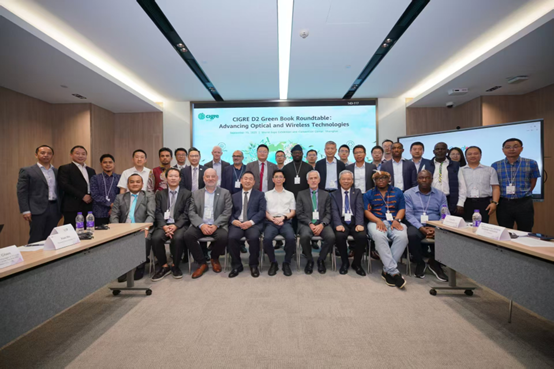
19 September 2025 | Shanghai, China
Purpose of the Roundtable
The CIGRE Study Committee D2 (Information Systems and Telecommunications) held a pivotal international roundtable in Shanghai, China, on September 19, 2025, focusing specifically on optical and wireless communications for power utilities. Building upon two prior online sessions, this first in-person meeting aimed to advance the revision of the optical and wireless communication chapters for the prestigious CIGRE Green Book series, with direct contributions to relevant working groups, including WG D2.62 (Private Wireless Networks for Power Utilities) and WG D2.65 (All-Optical Communication Networks). The session brought together global experts to foster in-depth discussions on critical topics such as wireless spectrum management, the evolution of optical transmission technologies, and communication requirements for power system protection.
Key Outcomes & Technical Insights
1. Opening and Strategic Context
Hosted by the CIGRE China National Committee D2, the session opened with a warm welcome from Mr. Kunlun Gao, who emphasized the importance of collaborative international expertise in shaping the future of power system communications. Mr. Marcio Szechtman provided an overview of the impactful Green Book initiative, which has seen over 440,000 chapter downloads globally since 2014, underscoring its role as a key technical resource.
Ms. Jianing Li outlined SC D2's vision and mission, highlighting its commitment to developing unbiased, internationally recognized guidance in strategic areas like digitalization, telecommunications, and cybersecurity, all conducted under strict CIGRE ethical and procedural guidelines.
2. The Critical Role of Private Wireless Networks & Spectrum
Mr. Qiang He set the stage by explaining how private wireless networks are a key enabler for addressing the digital transformation and new energy integration challenges facing modern power grids. A dedicated discussion on wireless spectrum, moderated by several experts including Mr. Gosta and Mr. Vincent, identified primary use cases for connecting critical infrastructure like smart grids and distributed generation. Key challenges highlighted included ensuring multi-vendor interoperability and achieving reliable, deep-coverage connectivity, for which licensed, low-band spectrum (such as 450MHz) was strongly advocated.
Mr. Gosta's presentation on 450MHz Global Practices solidified this view, detailing how the 450MHz band's characteristics—wide coverage, high reliability, and maturity—make it ideally suited for utility digitalization, supporting control, collection, and trunking services. These insights provide valuable input for WG D2.62.
3. Advancing Optical Transmission: Evolving Beyond Legacy SDH (Synchronous Digital Hierarchy)
A significant portion of the roundtable was dedicated to the evolution of optical transport. Dr. Xiang Liu provided a comprehensive ITU-T Standards ITU-T G.709/Y.1331 (2020) Amd.3 (03/2024). Experts discussed the need for next-generation optical technologies to overcome the bandwidth limitations of legacy SDH systems, which are increasingly challenged by digital and AI-driven services. The TDM (Time Division Multiplex) technologies (SDH/fgOTN/OTN) and the packet technologies (MPLS-TP/IP MPLS) are compared with pros and cons to carry power grid services. The prevailing view is that the TDM technologies provide hard isolation and deterministic latency capabilities, while the packet technologies have higher bandwidth efficiency and flexibility, one of the optimal solutions is the combination of different technologies for OT & IT services. These outcomes directly support the ongoing work of WG D2.65.
4. Communication for Power System Protection
Mr. Xinzhi Chen outlined stringent communication requirements for relay protection services, emphasizing the need for a one-way delay not exceeding 10 ms and a Bit Error Rate (BER) of =10?6. These criteria form a critical benchmark for evaluating any next-generation communication network intended for power system protection.
Summary and Forward Look
In his closing remarks, Mr. Fuyou Sun summarized the key consensus points:
- Wireless: Private wireless networks, particularly in the 450MHz band, are essential for medium-voltage communication and core grid services. Proactive engagement with regulators for dedicated spectrum is crucial.
- Optical: There is a clear industry trend to evolve from SDH towards more robust, high-capacity, and secure main transmission networks. Evolving optical transport technologies, which incorporate key features such as hard pipe isolation and deterministic low latency, were recognized as a pivotal direction for building the power communication network of the digital era.
The roundtable successfully gathered valuable insights and fostered international consensus, providing critical input for the ongoing Green Book revision and setting a clear technical direction for global power utility communication networks, while also enriching the work of WG D2.62 and WG D2.65.