
Corrosion in overhead lines
.jpg) |
.jpeg) |
.jpg) |
|||
|
Rob Meijers Convenor of WG B2.65 |
Cécile Rozé Convenor of WG B2.68 |
Pierre Van Dyke Chair SC B2 |
Corrosion shortens the service life of all types of metallic assets by causing their premature deterioration and, in some cases, leading to accidents. Even highly localized corrosion with only minor material loss can result in severe consequences. It is estimated that approximately 15% to 35% of corrosion-related costs can be avoided through improved corrosion prevention and control measures.
Many overhead lines (OHLs) around the world are approaching or have already exceeded their original design life. Because they are continuously exposed to environmental conditions, their physical condition is a key factor in decisions regarding replacement or life extension following an assessment of their degradation.
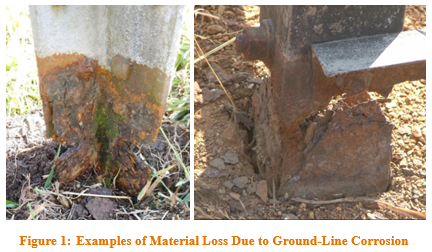
Direct-embedded steel foundations operate in aggressive and non-uniform soils, where corrosion behaviour is driven by multiple interacting processes influenced by soil properties, electrochemical gradients, and nearby infrastructure (Figure 1). Anchored tower structures in OHL systems offer economic advantages, but corrosion of anchor shafts has proven to be a critical vulnerability (Figure 2).
.png)
Different forms of atmospheric corrosion can also affect conductors and fittings. However, the primary corrosion mechanisms in conductors are galvanic corrosion of the zinc coating (Figure 3) and crevice corrosion of aluminium strands near contact points with other strands or fittings (Figure 4).
.png)
.png)
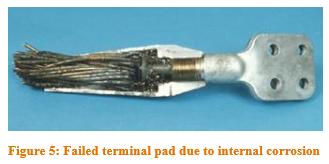
Corrosion of joints (Figure 5) is a significant concern because elevated temperatures resulting from Joule heating in both the conductor and the joint can accelerate corrosion and lead to failures, particularly where improper handling or installation has occurred.
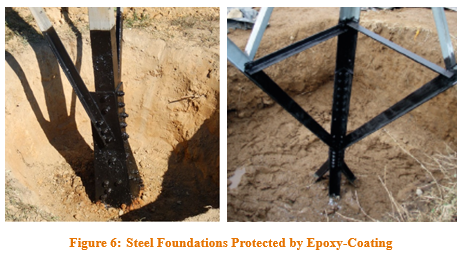
Fortunately, several methods can be used to mitigate and prevent corrosion, such as increasing steel thickness to provide a corrosion allowance or applying protective barriers that reduce exposure to moisture and corrosive ions (Figure 6). For conductors operating in a given environment, larger strand diameters generally exhibit a lower probability of failure. Conductor greasing is also commonly used as a corrosion prevention measure.
Inspection methods range from simple foot patrols, during which inspectors move from tower to tower, to line-mounted robots used for conductor inspections and aerial inspection techniques. Assessing corrosion risk for steel foundations, overhead structures, and conductors requires consideration of different factors, including soil conditions for foundations and atmospheric corrosivity for conductors. Research is also ongoing to improve corrosion detection techniques.
For more information on overhead line corrosion, readers are encouraged to consult Technical Brochure 905 Sustainability of overhead line conductors and fittings – Conductor condition assessment and life extension, Volume 1: State of the art, Technical Brochure 978 Detection, prevention and repair of sub-surface corrosion in overhead line supports, anchors and foundations, and Sustainability of overhead line conductors and fittings – Conductor condition assessment and life extension, Volume 2: Asset management considerations, which is scheduled for publication at the end of 2026.