
IPv6 and SRv6 in Power Utilities – Are we there yet?
 |
 |
 |
 |
||||
|
Victor Tan Chair of Study Committee D2 |
Peter Ceferin SC D2 Member, Slovenia |
Zwelandile Mbebe SC D2 Member Telecomms AG Convenor, South Africa |
David Sun SC D2 Member, China |
The energy transition continues to place greater demands on our telecommunications infrastructure. Renewable generation, distributed energy resources (DER), electric vehicles and smart metering are multiplying the number of connected devices, and the networks that carry our critical operational and enterprise traffic must evolve with them.
In this article, I would like to examine a question that many utilities are asking. Where do IPv6 (Internet Protocol version 6), and the segment routing technology built on top of it, SRv6 (Segment Routing over IPv6), fit in the future of power utility networks? I am joined by three Study Committee D2 expert contributors who bring perspectives from three continents, and I will close with the announcement of a new working group dedicated to exactly this topic.
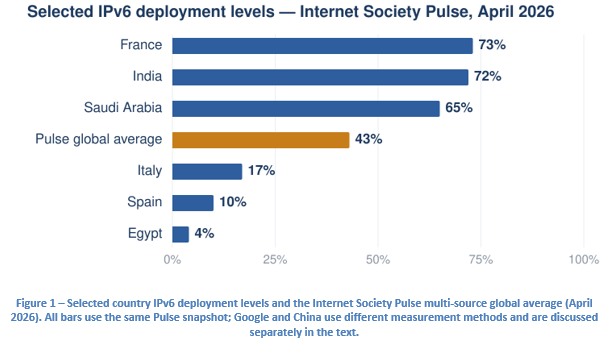
IPv6 is no longer a niche technology. Google measured 47.74% of its global users reaching its services over IPv6 in July 2026 [1], after recording a one-day peak of 50.10% in March 2026, and the Internet Society Pulse multi-source global average stood at 43% in April 2026 [2]. Adoption remains uneven (Figure 1). France (73%), India (72%) and Saudi Arabia (65%) led the Pulse country figures, while Italy (17%), Spain (10%) and Egypt (4%) trailed [2].
Where adoption has surged, it is because address demand left no alternative. The world’s largest mobile operators simply could not obtain enough IPv4 addresses for their subscribers. Reliance Jio and T-Mobile US measured above 90% IPv6 deployment [3], and T-Mobile US has operated an IPv6-only mobile network since 2014, using 464XLAT translation to preserve IPv4 application compatibility [4]. In Australia, just over 80% of Telstra’s users are IPv6-capable [5]. China has taken adoption furthest at the national scale, counting 869 million active IPv6 users by December 2025, approximately 77% of its Internet users, with IPv6 carrying around 70% of mobile network traffic [6].
Despite this momentum on the public Internet, IPv4 remains the cornerstone of enterprise and industrial communications. The APNIC Foundation observes that IPv6 adoption at large, brick-and-mortar enterprises has lagged, and relays the concern that overall Internet adoption may stall at around 60% unless this is addressed [7]. In my observation, power utilities are no exception, and often for good reasons. Our operational networks are privately addressed or isolated, so address exhaustion does not bite. Our asset lifecycles run fifteen to twenty-five years or longer, our operational technology (OT) implementations and tooling were built and certified on IPv4, and NAT, despite its shortcomings, has worked well enough where it is needed. Tellingly, the first CIGRE papers dedicated to IPv6 and segment routing in utility networks appear, to my knowledge, only at this year’s Paris Session [8].
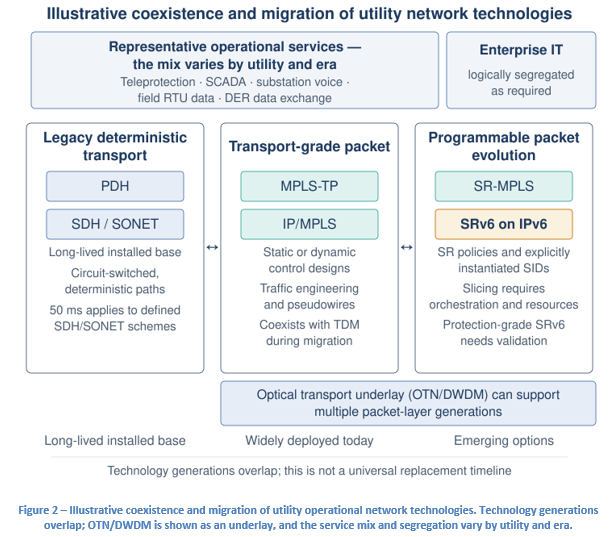
To see where IPv6 and SRv6 may fit, it helps to recall how we arrived here (Figure 2). The core networks supporting critical operations (teleprotection, SCADA, substation voice and field RTU data exchange) were traditionally carried on deterministic TDM networks built on PDH and SDH/SONET. As TDM equipment reaches obsolescence, utilities worldwide continue to migrate to packet networks engineered to behave like TDM transport networks, namely MPLS-TP and IP/MPLS with RSVP-TE, a migration SC D2 has documented extensively in our publications [9]. The current evolution adds advanced optical transport and segment routing, first over the MPLS data plane (SR-MPLS) and prospectively over IPv6 itself (SRv6).
The opportunities are appearing first at the edges of the grid, where the number of connected devices is largest. Wi-SUN field area networks, deployed for advanced metering and distribution automation, run IPv6 throughout. ISO 15118, the vehicle-to-grid communication interface behind Plug & Charge, specifies IPv6 at the network layer, and IEEE 2030.5, widely used for DER management, supports both IPv4 and IPv6.
Cellular IoT backhaul for metering and private 5G at substations point the same way, as does public policy, with the US federal government requiring at least 80% of IP-enabled federal assets to operate IPv6-only by the end of FY2025 (OMB M-21-07). Zwelandile Mbebe, our SC D2 member from South Africa, makes the practical point that when the endpoint count moves from thousands to hundreds of thousands, unique addressing and stateless autoconfiguration become essential rather than merely convenient. IPv6 also removes the overlapping private address ranges that utilities commonly accumulate through mergers, acquisitions and turnkey deliveries.
This brings us to SRv6, which I regard as the most compelling reason for utilities to take IPv6 seriously (Figure 3). The IETF segment routing architecture defines two data-plane flavours, SR-MPLS and SRv6 [10]. SRv6 is built directly on IPv6. Its active segment identifier (SID) is an IPv6 address carried in the packet’s destination address, a Segment Routing Header (SRH) carries the remaining segments when a policy has more than one, and each SID is bound to a defined behaviour at the node that owns it [11]. Drawing on our contributors’ input, the practical attractions and trade-offs for utilities are the following:
- Reduced protocol machinery, in a defined design. Segment routing can eliminate LDP and RSVP-TE by encoding the path at the headend, although an SRv6 design is not automatically simpler than every IP/MPLS design.
- Fast reroute protection suited to utility topologies. TI-LFA [12] provides guaranteed backup coverage in two-connected networks such as utility rings. Recovery below 50 ms is an engineering objective rather than a standards guarantee, and depends on failure detection, implementation and topology.
- One architecture that could extend from the transmission core towards the grid edge. An endpoint participates only if it is SRv6-aware and explicitly configured; IPv6 addressing alone does not make a device part of an SRv6 domain.
- Traffic engineering and service steering using explicit SIDs, with per-flow policy state held at the headend rather than at every transit node.
.png)
These technologies are no longer purely theoretical in the power industry. Peter Ceferin, our SC D2 member from Slovenia, reported production experience in a distribution utility’s closed medium-voltage loop, where SR-MPLS carries GOOSE messaging between protection relays for fault location, isolation and service restoration (FLISR). With TI-LFA and bidirectional forwarding detection tuned to three 10 ms detection intervals, the measured recovery times were under 35 ms, well within the recovery expectations set in the SDH era.
In China, David Sun, our SC D2 member from China, reports that IPv6 and SRv6 have moved into the power sector at scale. The data communication networks of State Grid and China Southern Power Grid are undergoing IPv6/SRv6 reconstruction, and China Southern Power Grid has outlined its SRv6 architecture for grid networks in an IETF Internet-Draft [13]. More than twenty IPv6-enhanced (“IPv6+”) networks are in use in the electric power industry, with reported service-deployment and network O&M efficiency improvements of around 30%.
The contributors differ on maturity, and the disagreement is itself instructive. David regards the core IPv6 and SRv6 standards as mature enough for large-scale deployment. Peter’s assessment is that SR-MPLS remains the more mature and field-proven choice today, and that SRv6 should carry protection traffic only after rigorous testing of latency, jitter, switching times, OAM, security and implementation maturity. Zweli argues for a tiered architecture rather than a wholesale migration, with SRv6 as the strategic transport for the majority of elastic, any-to-any traffic, while hard-reserved deterministic transport is retained for the small set of Tier-1 services, such as line current differential protection and transfer trip, whose delay-symmetry and admission-control requirements must be examined first. His security observation deserves repeating. NAT “provides concealment, not protection”, and removing it safely requires the zone model, firewall policy and device identity scheme to be designed first. Implemented properly, IPv6 makes security explicit and auditable, whereas a poorly planned transition would weaken it.
Table 1 summarises how the candidate packet transport technologies for utility WANs compare, drawing together the standards positions and our contributors’ field experience. For the Tier-1 deterministic class Zweli describes, the IETF is finalising circuit-style SR policies, which associate two co-routed unidirectional SR policies to satisfy bandwidth, end-to-end recovery and persistent-path requirements [14].
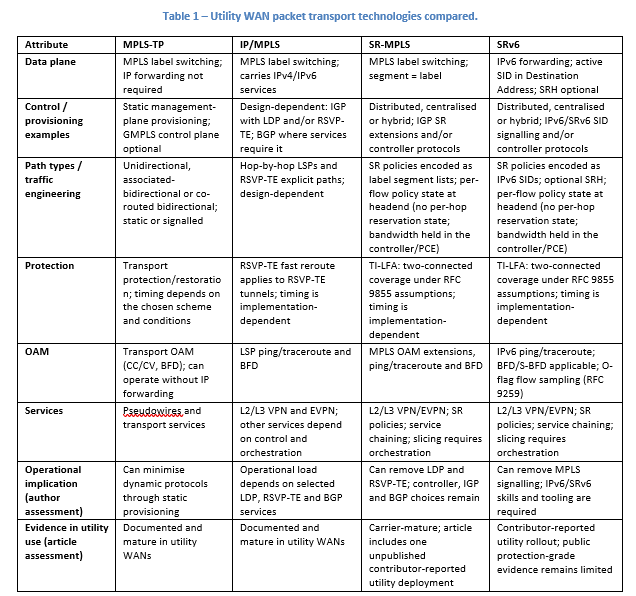
Sources: RFC 3209, 4090, 5036, 5921, 7432, 8287, 8402, 8754, 8986, 9252, 9259, 9491, 9543; CIGRE publications [9]; contributor field experience. Utility-maturity statements are the article’s assessment, not standards claims.
I will end with the announcement mentioned at the start of this article. Recognising both the opportunity and the open questions, a new working group, WG D2.70, “Technologies and Practices of Enhanced IPv6 Packet Networks for the Smart Grid”, has been established. The working group will analyse emerging smart grid services and their requirements, survey the current status of IPv6 adoption across the industry, examine the introduction of IPv6/SRv6 technologies into transmission and distribution networks, and formulate best practices for evolving utility communication networks from IPv4 to enhanced IPv6.
If the topics in this article are relevant to your utility’s plans, I encourage you to contact your National Committee about participating.
Returning to the question in the title, we are not there yet. The transition to IPv6 in our industry will take decades, much like the TDM-to-packet migration before it, and a complete transition is not a given. It will depend on the value the technology brings and the real problems it solves in the power industry. As our contributors have shown, however, the building blocks are taking shape, with an addressing architecture that scales to the grid edge and a programmable transport layer capable of carrying services ranging from teleprotection to DER telemetry. Now is the right time for utilities to build their understanding of these technologies.
I thank Peter Ceferin, Zwelandile Mbebe and Fuyou (David) Sun for their contributions to this article.
References
[1] Google, “IPv6 Adoption Statistics”, google.com/intl/en/ipv6/statistics.html – 47.74% of users accessing Google over IPv6 as at 20 July 2026 (accessed 23 July 2026).
[2] M. Ford, “18 Years Later, IPv6 Reaches Majority”, Internet Society Pulse, 21 April 2026 – Google first recorded 50.10% native IPv6 access on 28 March 2026; multi-source global average 43%; country figures France 73%, India 72%, Saudi Arabia 65%, Italy 17%, Spain 10%, Egypt 4%.
[3] World IPv6 Launch, “Network Operator Measurements”, June 2022 (site archived) – Reliance Jio 92.58%, T-Mobile USA 92.31% IPv6 deployment.
[4] Internet Society Deploy360, “Case Study: T-Mobile US Goes IPv6-only Using 464XLAT”, 2014; see also RFC 6877 (464XLAT).
[5] APNIC Labs, “IPv6 Per-Country Deployment for AS1221 (Telstra), Australia”, stats.labs.apnic.net/ipv6/AS1221 – 81–83% of sampled Telstra users IPv6-capable in the week to 22 July 2026.
[6] China National IPv6 Development Monitoring Platform (china-ipv6.cn) – 869 million active IPv6 users (77.38%) at December 2025; see also APNIC Blog, “China reports major IPv6 growth”, December 2025.
[7] APNIC Foundation, “IPv6 Deployment at Enterprises” – “IPv6 adoption at large, brick-and-mortar enterprises has lagged”; relays the concern that overall Internet adoption may stall at around 60%.
[8] CIGRE Paris Session papers D2-11577 and D2-10333 (2026), on IPv6+/SDN deployment for smart grid data networks and on segment routing for differential protection.
[9] CIGRE TB 461 (2011), “Telecommunication Service Provisioning and Delivery in the Electrical Power Utility”; CIGRE Session papers D2-308 (2020) on TDM-to-packet migration and B5-222 (2020) on protection over IP/MPLS.
[10] RFC 8402, “Segment Routing Architecture”.
[11] RFC 8754, “IPv6 Segment Routing Header (SRH)”; RFC 8986, “Segment Routing over IPv6 (SRv6) Network Programming”.
[12] RFC 9855, “Topology Independent Fast Reroute Using Segment Routing” (TI-LFA), October 2025.